
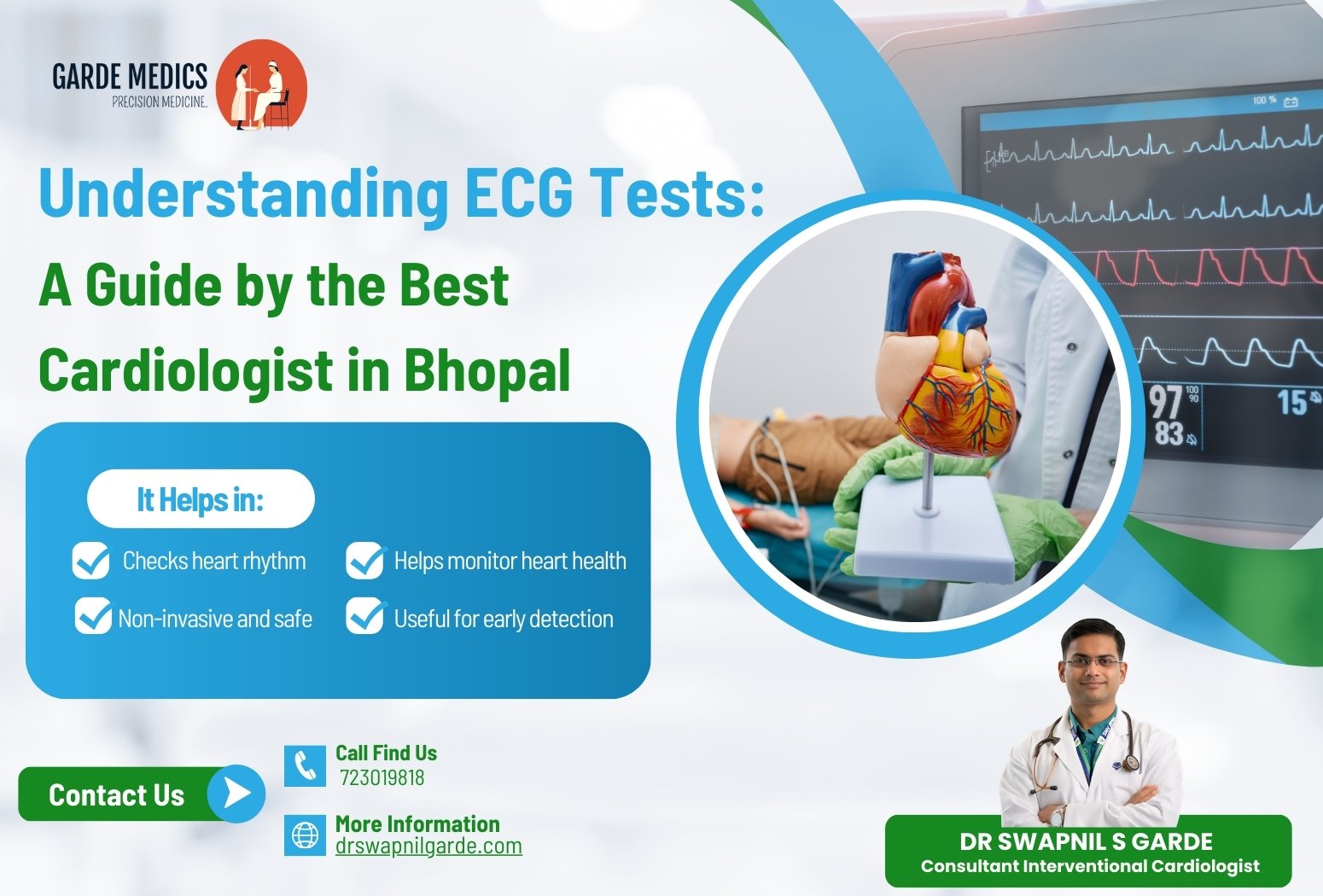
Your heart sends thousands of tiny electrical signals every single day to keep you alive and active, and understanding these signals is essential for good heart health. An ECG test helps doctors read these signals and evaluate how well your heart is working. When guided by the Best Cardiologist in Bhopal, this simple test becomes a powerful tool for early detection and prevention of serious heart problems.
At Garde Medics, patients receive accurate diagnosis and expert cardiac care under the leadership of Dr. Swapnil S. Garde, one of the known Cardiologists in Bhopal. He believes that patients should clearly understand their tests and reports, without fear or confusion. This approach ensures that every patient undergoing the Best ECG test in Bhopal feels informed, confident, and well cared for throughout their heart health journey.
What Is an ECG Test?
An ECG (Electrocardiogram) is a simple, painless, and non-invasive test that records the electrical activity of the heart Best ECG test in Bhopal. Every heartbeat occurs because of tiny electrical signals, and an ECG machine captures these signals and displays them as wave patterns on a screen or paper.
Doctors use ECG tests to:
- Check heart rate and rhythm
- Detect irregular heartbeats
- Identify signs of a past or ongoing heart attack
- Assess stress or strain on the heart muscle
Getting the Best ECG test in Bhopal under the guidance of the Best Cardiologist in Bhopal ensures accurate interpretation of results and timely, appropriate heart care.
Types of ECG and Heart-Related Tests
Many people search online to understand the different heart tests recommended by doctors. While ECG is the first step in heart evaluation, several other heart-related tests help provide a complete picture of heart health. Below, we explain the most commonly searched tests in simple terms.
1. Doppler Echocardiography
This test uses ultrasound waves to study blood flow within the heart. It helps detect valve leakage, narrowing, or abnormal blood flow and is commonly advised when heart murmurs or valve diseases are suspected.
2. Transthoracic Echocardiography (TTE)
This is the most commonly performed echo test. A probe is placed on the chest to view heart chambers, valves, and pumping strength, making it useful for routine heart evaluation.
3. Transesophageal Echocardiography (TEE)
In this test, the ultrasound probe is passed through the food pipe to obtain clearer and more detailed images of the heart’s internal structures. It is recommended when precise imaging is required.
4. Stress Echocardiography
This test evaluates how the heart performs under physical or medical stress. It is especially helpful in detecting blocked heart arteries that may not be visible when the body is at rest.
5. Fetal Echocardiography
This specialized test examines the heart of an unborn baby during pregnancy and helps detect congenital heart defects at an early stage.
Although these are echo-based tests, they are often advised along with ECG to ensure complete and accurate heart evaluation by the Best Cardiologist in Bhopal.
What Is an ECG Test Used For?
An ECG test is one of the most commonly used and trusted tools for evaluating heart health Best ECG test in Bhopal. It helps doctors understand how well the heart is functioning and identify problems at an early stage.
An ECG test is commonly used to:
- Detect heart rhythm problems, such as irregular, fast, or slow heartbeats
- Identify heart attacks, whether they are ongoing or occurred in the past
- Monitor existing heart conditions and assess how the heart responds to treatment
- Check heart health before surgery, ensuring the heart can safely handle medical procedures
- Evaluate symptoms like chest pain or breathlessness, which may indicate heart-related issues
Because of its accuracy and speed, ECG plays a vital role in early detection of heart problems, helping doctors make timely and life-saving decisions.
When Is an ECG Test Performed?
An ECG test is usually performed when a person experiences symptoms that may indicate a heart-related problem. These symptoms should never be ignored, especially if they appear suddenly or worsen over time.
An ECG test is advised if you experience:
- Chest pain or discomfort, which may indicate reduced blood flow to the heart
- Shortness of breath, especially during rest or mild activity
- Dizziness or fainting episodes, which can be linked to heart rhythm issues
- Fast or irregular heartbeat (palpitations)
- Unexplained fatigue or weakness that does not improve with rest
Even in the absence of symptoms, an ECG screening may be recommended for people with diabetes, high blood pressure, high cholesterol, or a family history of heart disease. Regular ECG checks help in early detection and prevention of serious cardiac conditions.
Why Might I Need an Electrocardiogram?
You may need an electrocardiogram (ECG) even if you feel “almost normal,” because many heart problems develop quietly without clear warning signs. An ECG helps detect hidden issues before they become serious.
The Best Cardiologist in Bhopal may advise an ECG to:
- Rule out serious heart conditions such as abnormal heart rhythms or early signs of a heart attack.
- Monitor ongoing heart disease and track how your heart is responding to treatment.
- Check the effects of medicines on the heart, especially drugs that can influence heart rhythm or rate.
- Prevent future complications by identifying problems early and planning timely care.
Early detection through ECG testing can truly save lives and protect long-term heart health.
What Happens During an Electrocardiogram?
An electrocardiogram (ECG) is a simple, safe, and comfortable test. Here’s what you can expect during the procedure:
- You lie down comfortably on an examination bed so your body stays relaxed during the test.
- Small electrodes are gently placed on your chest, arms, and legs. These electrodes only record electrical signals; they do not give shocks.
- The ECG machine records your heart’s electrical activity and displays it as wave patterns for analysis.
- The entire test takes about 5–10 minutes, making it quick and convenient.
- There is no pain, no injection, and no risk involved at any stage of the test.
At Garde Medics, every ECG report is carefully reviewed by Dr. Swapnil S. Garde, ensuring accurate interpretation and reliable diagnosis for your heart health.
What Happens After an ECG?
After your ECG test is completed, the next steps are just as important as the test itself. Here’s what usually happens:
Doctor reviews the ECG report:
The ECG results are carefully analyzed to check heart rhythm, rate, and any abnormal electrical patterns.
Results are explained clearly:
The doctor explains the findings in simple, easy-to-understand language so you know exactly what the report means for your heart health.
Further tests may be advised:
If required, additional investigations such as blood tests, echocardiography, or stress testing may be recommended for a more detailed evaluation.
Important fact to know:
Nearly 30–35% of heart attacks can have a normal ECG, especially in the early stages. This is why ECG results should never be assessed in isolation.
Consulting the Best Cardiologist in Bhopal ensures accurate interpretation, timely diagnosis, and the right treatment decisions for your heart.
Is a Normal ECG Always Safe?
No. A normal ECG does not always mean that the heart is completely healthy. While ECG is an important screening tool, some heart attacks, early blockages, or heart muscle problems may not show immediate changes on an ECG, especially in the early stages.
To ensure accurate diagnosis, doctors often combine ECG with:
Blood tests:
These help detect heart muscle damage and ongoing cardiac stress that may not appear on ECG results.
Echocardiography:
This test shows the structure and pumping strength of the heart, helping identify valve problems or weakened heart muscles.
Stress tests:
These assess how the heart performs during physical activity and help detect blocked arteries that may not be visible at rest.
Using this complete and combined approach allows doctors to make safer, more accurate decisions and provide the right treatment at the right time.
How Accurate Is an ECG Test?
An ECG test is a reliable and widely used heart test, but it works best when interpreted correctly and combined with clinical evaluation. Here’s a clear explanation in detail:
- Detects heart rhythm problems:
ECG is highly effective in identifying irregular heartbeats such as fast, slow, or uneven heart rhythms. These rhythm issues are often the first sign of an underlying heart condition. - Helps identify major heart attacks:
ECG can detect clear electrical changes in the heart that occur during many major heart attacks, allowing doctors to take quick and life-saving action. - Useful for ongoing heart monitoring:
ECG is commonly used to monitor known heart conditions, assess response to treatment, and track changes over time. - May not detect all heart problems:
Some heart attacks, early blockages, or mild heart conditions may not show changes on ECG, especially in the early stages. - Not a standalone diagnostic test:
ECG results must always be combined with symptoms, medical history, blood tests, and imaging studies for complete evaluation. - Expert interpretation is crucial:
Correct reading of ECG results by the Best Cardiologist in Bhopal ensures accurate diagnosis, avoids missed conditions, and guides safe treatment decisions.
This balanced approach makes ECG a powerful tool when used under expert cardiac care.
Why Choose Garde Medics for ECG Test in Bhopal?
When it comes to your heart, accuracy, experience, and trust matter the most. Garde Medics is a preferred choice for ECG testing because it combines advanced technology with expert medical care.
Expert Guidance:
Dr. Swapnil S. Garde evaluates ECG tests at Garde Medics, a highly experienced interventional cardiologist, ensuring correct interpretation and timely advice.
Advanced Equipment:
The clinic uses modern ECG machines for precise and reliable results.
Patient-Focused Care:
We give every patient enough time, provide clear explanations, and offer personalized attention.
Scientific Approach:
Doctors assess ECG results along with symptoms, medical history, and other tests when needed.
Affordable & Transparent:
We offer ECG testing at reasonable costs without compromising on quality.
Digital Records:
We safely store medical data and ECG reports in digital format to ensure easy follow-up and continuity of care.
Choosing Garde Medics means trusting your heart to expertise, ethics, and compassionate care guided by the Best Cardiologist in Bhopal.
Patient Testimonial
“Even though my ECG looked normal, Dr. Swapnil S. Garde listened carefully and advised further tests. That timely decision protected my heart. I am grateful to the Best Cardiologist in Bhopal for his thoughtful care.”
Frequently Asked Questions (FAQs)
Is the ECG test painful?
No. An ECG test is completely painless and safe, and when performed under the guidance of the Best Cardiologist in Bhopal, it is a quick and stress-free experience.
How long does an ECG test take?
An ECG test usually takes about 5–10 minutes, making it one of the fastest and most reliable heart tests offered at the Best ECG test in Bhopal facilities.
Can ECG detect all heart problems?
No. While ECG is an important diagnostic tool, it cannot detect all heart conditions and is often combined with other tests by the Best Cardiologist in Bhopal for accurate diagnosis.
Where can I get the Best ECG test in Bhopal?
You can get the Best ECG test in Bhopal at Garde Medics, under the expert care of Dr. Swapnil S. Garde, ensuring accurate results and proper guidance.